AirTag accessory guide
AirTag holders for kids: every type, compared
You have the tag. Now you have to put it somewhere, and the listings all promise the same two things: hidden, and secure. Here are the seven ways parents actually do it, judged on the only question that decides any of them, plus the part the product pages leave out.
Author: Muarij Kerio · Reviewed 16 September 2026
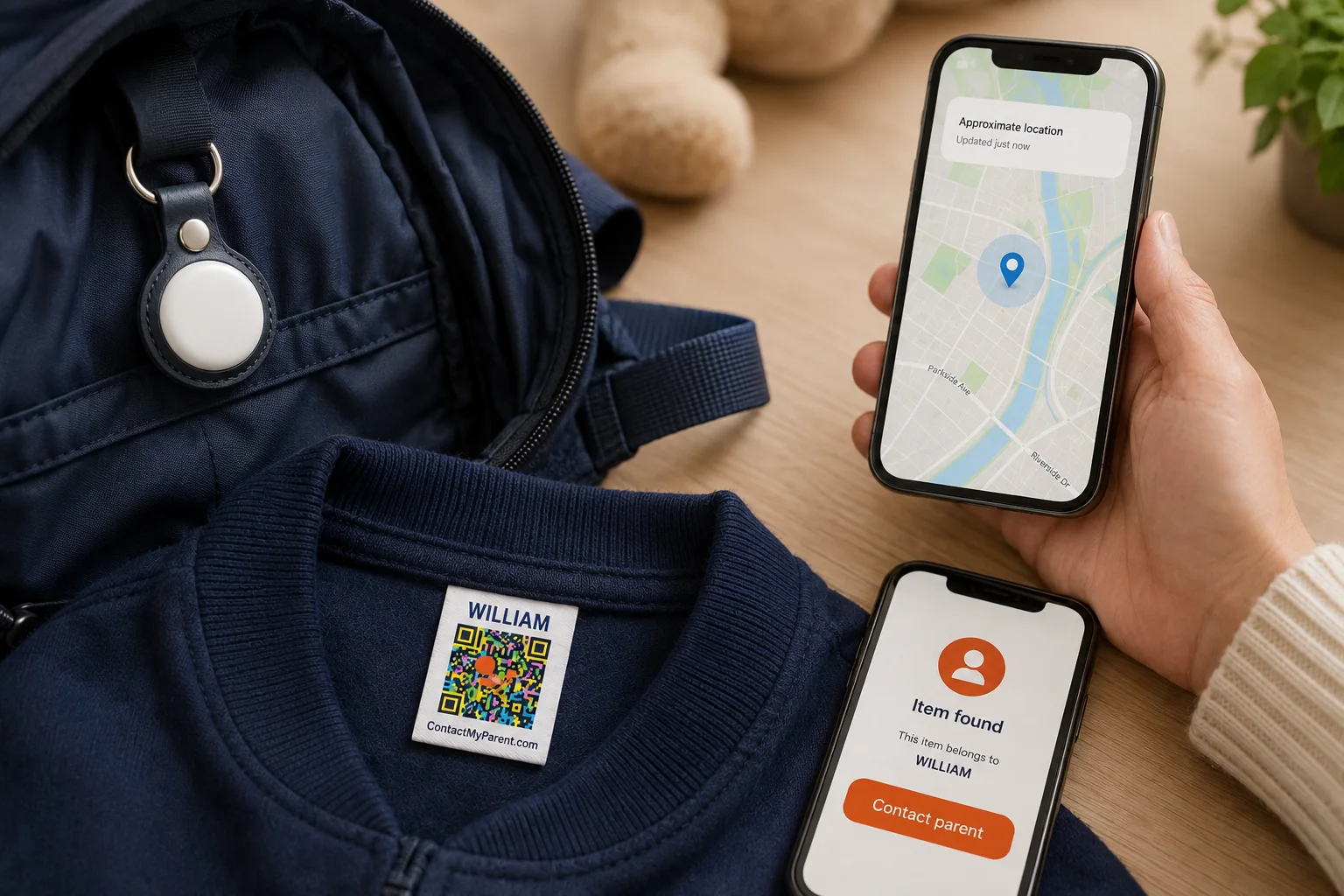
The short answer
- Toddler: a shoe. Either a pouch laced on, or shoes with a compartment built in. It is the one place a small child will not pick at.
- School-age child: a clip on the backpack, as long as you are honest that you are tracking the bag.
- A specific day out: a wristband is fine for a child old enough to leave it alone.
- Never: a cord or lanyard round the neck of a young child.
Two things worth knowing before you spend anything. No holder, however well hidden, stops the tag announcing itself to the adults around your child. And a holder is a second purchase on top of the $29 tag, per child and per item, which is why most families end up with exactly one tagged bag.
The seven ways to attach one
The second column is the one to read first. Everything else is comfort and looks.
| How you attach it | Can your child take it off? | Best for | The catch |
|---|---|---|---|
| Silicone wristband or bracelet | Easily. This is the one toddlers defeat first | An older child, on a specific day out | Slides off wet skin at a pool or a water park, and the cheap ones split at the seam |
| Pouch laced into a shoe | Not while the shoes are on | Toddlers and preschoolers who pull at anything on their wrist | Only that one pair, and shoes come off indoors: soft play, a friend's house, the sand pit |
| Shoes with a built-in compartment | No. It screws shut under the insole | The tidiest version of the shoe idea | $52 to $58 a pair, the tag is sold separately, and the maker says take it out before washing |
| Clip or keychain case on a backpack | Yes, and so can anybody else | Finding the bag, which is what it is really for | Visible, and the first thing to go if the bag itself goes |
| Sewn-in or Velcro pocket inside a garment | Not if it is properly sewn in | One coat that gets worn every single day | You have to remember to take it out before every wash, and it covers one garment |
| Safety-pin or concealed clothing case | Harder than most | What the market is plainly asking for | An exposed pin near a small child, and it still does not stop the tag being detected |
| Necklace or lanyard | Yes | Nothing, for a young child. See below | A cord at a child's neck is a recognised strangulation hazard |
Built-in shoe compartment pricing from Skechers, Find My Skechers, checked September 2026. The AirTag is sold separately in every case.
The necklace option, and why to skip it
AirTag necklaces sell well, and they are the one item on the table we would tell you to leave alone for a young child.
Cords at a child's neck are a long-established hazard in their own right. US regulators treat neck and hood drawstrings on children's outerwear as a substantial product hazard, after 26 deaths and 73 non-fatal incidents recorded between 1985 and 2019 in children aged 18 months to 15 years. The most common scenario was not what people picture: a drawstring catching in a gap at the top of a playground slide as the child went down. (US Consumer Product Safety Commission)
That rule is about drawstrings, not about AirTags. Nobody has written a rule about AirTag necklaces. But the object is the same: a cord at the neck of a child who is about to go down a slide, with a hard lump on the end of it. Plenty of nurseries and schools will not allow one, and they are right not to.
If the appeal of a necklace is that it stays with the child rather than the bag, put the information on the clothing instead. That is the same instinct, without the cord.
Three things no holder fixes
Whichever you buy, you are left with the same three gaps, because they belong to the tag rather than to the thing holding it.
- It still announces itself. Covered above. Any adult spending the day with your child may be told about it, and can then find it and take it out.
- It still has no GPS. An AirTag has no GPS chip and no cellular connection. It borrows the position of passing iPhones, so you see where it was rather than where it is, and in a quiet place you may see nothing useful at all. (Apple, AirTag)
- It still gives the finder nothing. This is the big one. Whoever is standing with your lost child is holding a phone, and the tag in the shoe is talking to you, not to them. Lost Mode lets an NFC phone tap the tag to see your number, which asks the finder to spot a hidden disc, own the right phone, and think of it while holding a crying child.
Whatever holder you choose, keep the coin-cell battery inaccessible. Button cells are dangerous if swallowed, and a good holder should need an adult's effort to open.
The alternative to attaching anything
Every row in that table is an attempt to keep a loose plastic disc fixed to a child who is running about. There is a version of this problem that does not involve attaching anything, because the information goes into the clothes.
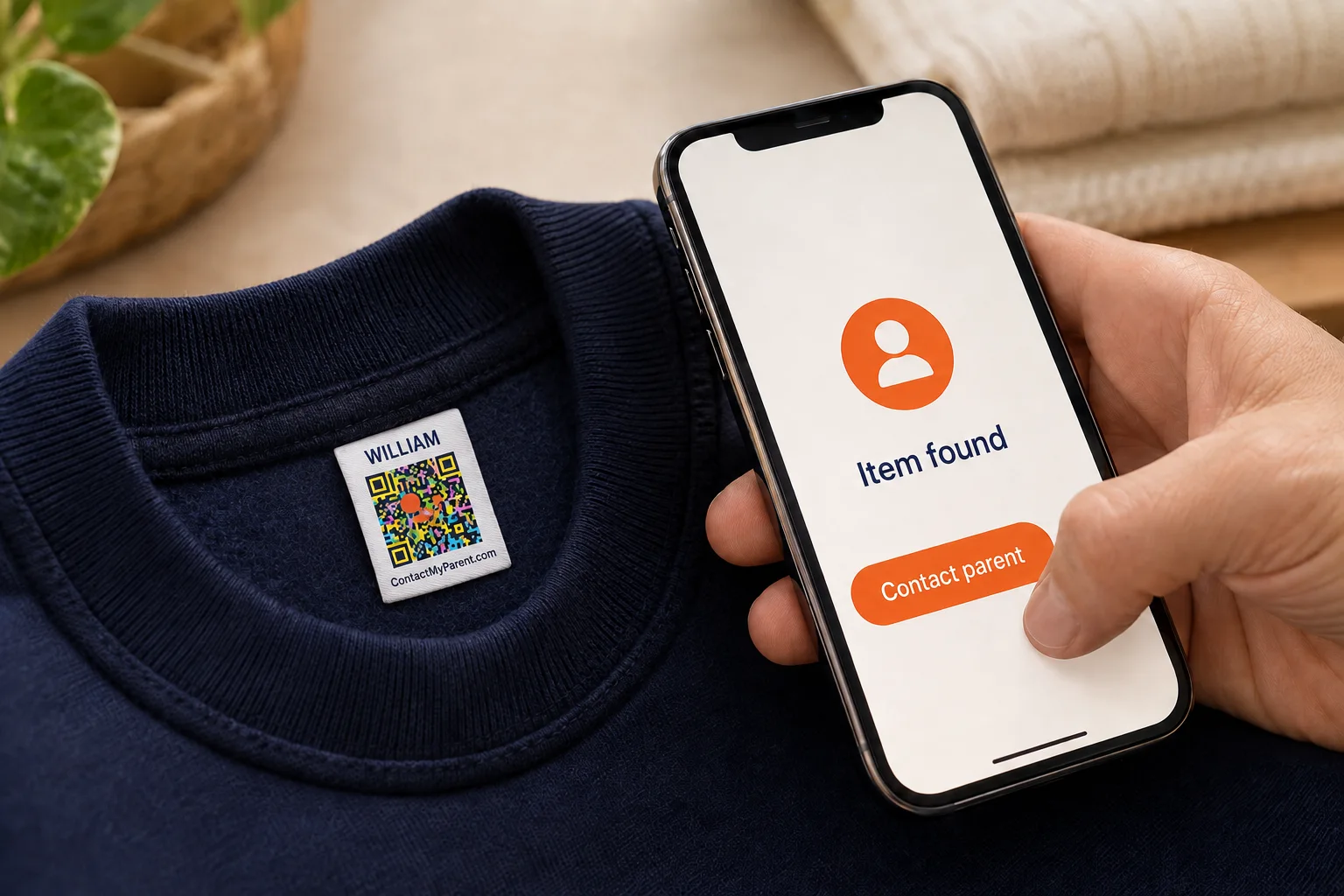
A ContactMyParent iron-on label goes into the collar once and stays through the wash. A sticker goes on the bottle and stays on the bottle. Whoever finds your child points a phone camera at it and reaches you: no app, no NFC, no account, no battery, and nothing for a child to pick at.
Ten of them cost $14, which is less than most people spend on holders alone. What it will never do is show you a map, and if that is what you came for, the tag in the shoe is the right call.
But can't anyone scan a QR code on a child?
Fair question, and the same one you should be asking of a hidden holder.
What is printed is a first name and a code. No number, no address, nothing a stranger can read off a collar from across a room. The code points at a page you control, and you choose what a finder sees: your contact details, so they can call you in one tap, or a message form that reaches you while showing them nothing at all.
You switch between the two from your phone whenever you like. Private on the school run, visible at the airport, if that suits you. Once a phone number is printed on a tape sewn into a coat, by contrast, it is there for the life of the garment.
If you are buying a holder anyway
Nothing here is an argument against owning an AirTag. It is good at finding a bag in a crowded place. If you are buying a holder, five things worth checking:
- Can an adult open it without a tool, and a child not at all? That is the battery question, and it matters more than the design.
- Does it survive water? The tag is rated IP67. Most holders are not, and a swim bag or a rainy walk to school will find that out.
- Will it stay on the thing your child actually wears? A holder on the coat that lives on a peg all winter is a holder on a peg.
- Are you buying more than one? Cost per item is the thing that catches people. A tag plus a holder, per child, per item, adds up quickly.
- Have you told the school? Ask before term starts rather than after a confiscation, and warn the adults around your child that their phones may flag it.
Then put a name and a way to reach you on the clothes, because the holder solves where the tag sits, and none of them solve who your child is standing with.
Questions parents ask
Is there a hidden AirTag holder for kids?
Plenty are sold as hidden, invisible or concealed: pin-on cases, sewn-in pockets, and shoes with a screw-shut compartment under the insole. They hide the tag from the eye. They do not hide it from phones. Apple designed AirTag to be discoverable, so an unknown tag travelling with someone can raise an alert on iPhone and Android alike, and the tag itself starts playing a sound. Concealment changes what a person sees, not what their phone reports.
Where is the best place to attach an AirTag to a child?
For a toddler, a shoe, because it is the one thing they cannot easily remove and will not fiddle with. For an older child, a backpack clip is fine if you accept you are tracking the bag. A wristband works only for a child who will leave it alone. Avoid anything on a cord round the neck.
Can you put an AirTag in a shoe?
Yes. You can lace a pouch onto the shoe, or buy shoes with a compartment built into the insole, which Skechers now sells for around $52 to $58 with the AirTag bought separately. Both work. Both cover exactly one pair of shoes, so whatever your child wears on the days those shoes stay in the cupboard carries nothing.
Can you legally put an AirTag on your child?
For your own young child this is not the issue parents expect it to be. Apple's terms are aimed at tracking other people without their knowledge and consent, which is a different situation from a parent and a four year old. The practical constraints matter far more than the legal ones: the alerts, the sound, and the fact that other adults can find and remove the tag. This is general information and not legal advice.
Should you put AirTags on kids?
An AirTag is reasonable for finding a bag in a crowded place, and poor at almost everything parents imagine it doing. It has no GPS, it shows you where the tag was rather than where it is, and it gives the person actually standing with your child nothing they can use. Treat it as a way to shorten your own search, and put contact details on the clothes for the part a tracker cannot do.
How do you keep kids safe with an AirTag?
Use a holder that keeps the coin-cell battery inaccessible, skip neck cords, tell the adults around your child that their phones may flag the tag so nobody panics and bins it, and turn on Lost Mode. Then accept the gap it leaves: teach your child to say your phone number, and label the clothes so whoever finds them can reach you without an app.
Nothing to clip on, nothing to lose
Iron-on labels for clothing, waterproof stickers for bottles and bags. Ten for $14, and the finder needs nothing but a phone camera.