Data reference
Dementia wandering statistics: what the data actually shows
Every figure on this page is traced to a named primary source and linked. Where a widely repeated statistic could not be traced to a study, we say so rather than pass it on.
Compiled by Muarij Kerio · Sources checked 11 September 2026 · Free to quote with attribution · General information, not medical advice
The headline figures
Six numbers that cover the scale of the problem, the shape of a typical incident and the size of the affected population. Each links to its source.
The two numbers that appear to contradict each other
If you research this topic for more than an hour you will meet two figures that cannot both seem right.
Up to half
will suffer serious injury or death, if not found within 24 hours. (Alzheimer's Association)
6%
were harmed, across all 1,041 police-reported incidents. (BMC Geriatrics, 2025)
Both are true, because they describe different groups. The first is conditional. It applies only to people still missing after a full day. The second is unconditional: it counts every reported incident, including the large majority resolved quickly.
The Swedish registry shows how small that 24-hour group is. The median police search lasted 1.36 hours, and 56.5% of people were reported missing within two hours of last contact. An incident that runs past 24 hours is the extreme tail of the distribution, not the typical case.
Quoting the 50% figure without that context makes wandering sound like a coin flip. It is not. But the direction of travel it points at is real, and the registry data confirms it: time is the strongest single predictor of harm. Compared with people reported missing within two hours, the odds of harm were roughly five times higher once four to eight hours had passed since last contact (OR 4.94, p < 0.001).
Who actually finds them
This is the least discussed table in the literature and the most useful one for planning. From 1,041 Swedish police-reported incidents involving people living with dementia:
| Outcome | Share | What it means in practice |
|---|---|---|
| Found in a public outdoor space | 42.4% | A street, park, field or other open place. The finder is whoever happens to be there. |
| Located by police | 32.4% | The formal search succeeded. |
| Recovered by family or friends | 19.3% | Someone who already knew the person found them first. |
| Found at their own residence | 5% | They returned, or had not left. |
| Found at a personally significant place | 1% | A former home, workplace or other 'hotspot'. |
Source: Larsson et al., BMC Geriatrics, 2025. Categories describe location found and party recovering, so they overlap and do not sum to 100%.
Two things follow. First, roughly one in five people were recovered by family or friends rather than by police, so the household's own search matters as much as the formal one. Second, the largest single location category is a public outdoor space, where the person who encounters your parent is a passer-by: no training, no radio, no connection to your family, and no way to know who to call unless something on the person tells them.
What harm looks like when it happens
Of the 1,041 incidents, 61 people (6%) were harmed and four died. The causes, where recorded:
| Cause of harm | Cases |
|---|---|
| Fall-related injuries | 14 |
| Hypothermia | 10 |
| Lacerations | 8 |
| Poor general condition | 6 |
| Type of harm undetermined | 18 (30% of harm cases) |
Source: Larsson et al., 2025. Some cases involved a combination of causes.
Falls and hypothermia together account for most identified harm, which is why cold season was independently associated with harm in the study, alongside male sex, no prior missing incidents, time since last contact, delayed reporting and a prolonged search. The counter-intuitive one is worth sitting with: having no history of going missing predicted harm, plausibly because families of first-time wanderers are less prepared and slower to raise the alarm.
The population behind the percentages
The Alzheimer's Association's 2026 Facts and Figures report puts 7.4 million Americans aged 65 and over living with Alzheimer's, projected to reach 13.8 million by 2060 absent a medical breakthrough. Nearly 13 million Americans provide unpaid care for a family member or friend with dementia, contributing more than 19 billion hours of care in 2025, valued at more than $446 billion. (Alzheimer's Association, Facts and Figures)
Applying the Association's own 60% lifetime wandering estimate to that population is how most articles produce a dramatic national number. We have deliberately not done that arithmetic here, because lifetime risk and annual incidence are different quantities and multiplying one by a population count produces a figure that means nothing.
What official guidance says
“Make sure the person carries some kind of ID or wears a medical bracelet with their name and address, and your phone number. If you think the person might remove an ID bracelet, label their clothes with a name and phone number.”
National Institute on Aging, Coping With Alzheimer's Behaviors: Wandering and Getting Lost
The Alzheimer's Association's operational guidance is the 15-minute rule: search the immediate area and the places the person used to go, and if they are not found within 15 minutes, call 911 and report a missing person with dementia. Both bodies also advise telling neighbours and local police in advance, and keeping a current close-up photograph.
Read that second NIA sentence again. A federal health institute is telling families to do one specific thing when a bracelet will not stay on, and that thing is to label the clothes.
The table above is why it matters. The largest single category in the Swedish data is a person found in a public outdoor space, 42.4%, ahead of the 32.4% located by police. In those cases the finder is whoever happens to be standing there, and what they need is not a search. They need a way to reach you.
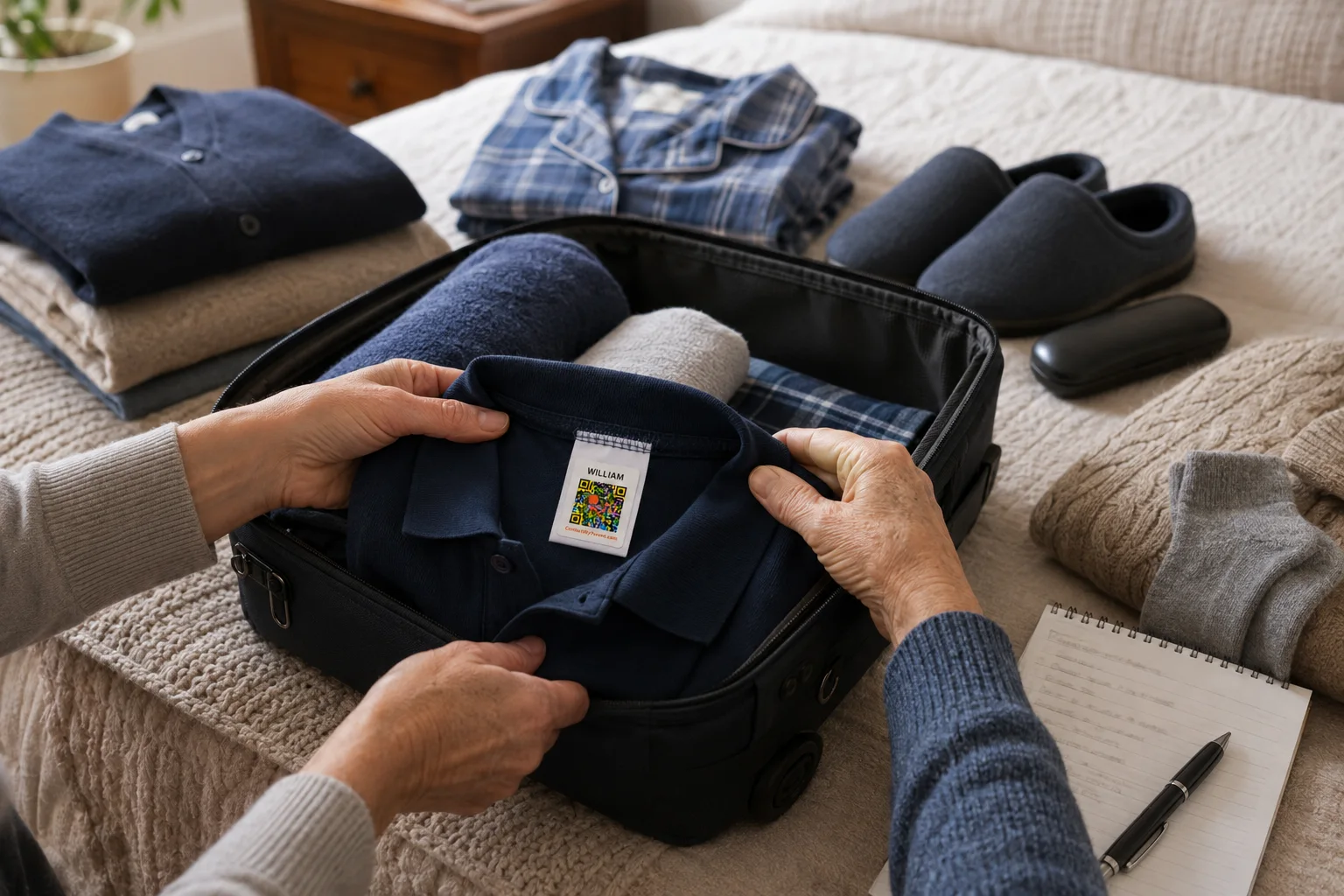
ContactMyParent dementia clothing labels iron onto the care tag, which is the whole point of the NIA caveat: a label on the inside of a garment cannot be taken off by the person wearing it. The profile behind the QR code carries the name, who to call, and anything you choose to add about the condition.
The honest boundary. The strongest single predictor of harm in this data is delay, and no label reports an incident for you. Call it in early. Our guide to labelling clothes for a care home covers the method in detail.
What the data does not tell you
Four limitations that anyone citing these figures should carry with them.
There is no national US dataset
The United States has no central register of dementia missing incidents. Silver Alert programs are run state by state with different eligibility criteria, different activation thresholds and different reporting, so state totals cannot be meaningfully added together or compared. Any figure presented as a national US count of dementia wandering incidents should be treated with suspicion unless it names its dataset.
The '50% within 24 hours' figure has no cited study
The Alzheimer's Association states on its emergency preparedness page that if a person is not found within 24 hours, up to half of wandering individuals will suffer serious injury or death. It is repeated across hundreds of care sites, almost always attributed to the Association. The Association does not cite an underlying study for it on that page, and we could not trace one. We quote it because it comes from the field's leading body, but it is guidance, not a measured rate, and it should not be presented as a research finding.
Police registry data misses everything resolved quietly
The Swedish study counts incidents reported to police. Every episode where someone walked out and a neighbour brought them back before anyone called is invisible to it. The true incidence of wandering is therefore higher than any police dataset can show, and the true harm rate is likely lower than 6%, because unreported incidents are the ones that ended well.
The 60% figure is lifetime risk, not annual
Six in ten people living with dementia will wander at some point across the course of the illness. It is not a statement that 60% wander in any given year, and it is regularly misreported that way.
How to cite this page
Journalists, students and care organisations are welcome to quote any figure here without asking. Where a statistic originates with the Alzheimer's Association, the National Institute on Aging or Larsson et al., please cite them as the source and use this page only for the comparison and context.
Found an error, or a primary source we missed? Tell us at our contact page and we will correct it and note the change.
Primary sources
- Alzheimer's Association. Wandering. Source of the six-in-ten, 1.5 miles and 15 minute figures.
- Alzheimer's Association. Preparing for Emergencies. Source of the 60% and the “up to half within 24 hours” statements.
- Alzheimer's Association. Alzheimer's Disease Facts and Figures. Source of the prevalence, caregiver and cost figures.
- National Institute on Aging. Coping With Alzheimer's Behaviors: Wandering and Getting Lost. Source of the identification and clothing labelling guidance.
- Larsson, R., Årestedt, K., Svensson, A., Andersson, Å., & Wolmesjö, M. (2025). Missing incidents and the risk of harm in persons living with dementia reported to the Swedish police: a nationwide retrospective registry study. BMC Geriatrics. Source of all incident-level figures.
Who compiled this, and why
ContactMyParent makes QR clothing labels, so we have a commercial interest in the finding that many people are located by members of the public. We have tried to counter that by flagging where the scariest available statistic is weakest, and by omitting the population arithmetic that would have made the problem look larger. No figure on this page was produced by us. If you think we have shaded any of it, the primary sources are all linked above so you can check.
Frequently asked questions
What percentage of dementia patients wander?
The Alzheimer's Association estimates that 60%, or six in ten people living with dementia, will wander and become lost at least once, and that many do so repeatedly. This is a lifetime figure covering the whole course of the illness, not an annual rate. It is the most widely used prevalence estimate in the field.
How far do people with dementia travel when they wander?
The Alzheimer's Association reports that many individuals who wander are found within 1.5 miles of where they disappeared. Swedish police registry data adds useful detail on where rather than how far: 42.4% of people were found in a public outdoor space, and only 1% at a personally significant location such as a former home, which undercuts the common assumption that people reliably head somewhere from their past.
How dangerous is dementia wandering, really?
It depends entirely on which population you measure. Across all 1,041 police-reported incidents in a 2025 Swedish nationwide registry study, 61 people (6%) came to harm and four died. The much-quoted claim that up to half suffer serious injury or death applies only to those still missing after 24 hours, which is a small and extreme tail: the median police search in the Swedish data lasted 1.36 hours. Both statements can be true because they describe different groups.
How quickly should you call the police?
The Alzheimer's Association advises calling 911 if the person is not found within 15 minutes. The Swedish registry supports acting fast: delayed reporting was significantly associated with harm, and the odds of harm were roughly five times higher once four to eight hours had passed since last contact compared with under two hours. Time was the single strongest predictor of harm in the study.
Who actually finds a missing person with dementia?
In the Swedish registry, police located 32.4% and family or friends recovered 19.3%. The largest single category, 42.4%, were found in public outdoor spaces, where the person who encounters them is typically a passer-by with no training and no connection to the family. That is why identification a stranger can act on matters alongside search technology.
Does official guidance recommend labelling clothing?
Yes. The National Institute on Aging advises that the person carries ID or wears a medical bracelet with their name, address and a phone number, and adds a direct instruction for people who remove jewellery: 'If you think the person might remove an ID bracelet, label their clothes with a name and phone number.'