Caregiver guide
How to stop dementia wandering at night
Why it happens, what stage to expect it, the routine and home changes that reduce it, the devices compared honestly, identification the person cannot take off, and exactly what to do in the first 15 minutes if they get out.
Author: Muarij Kerio · Reviewed September 2026 · Sourced from the Alzheimer's Association and the National Institute on Aging, linked inline · General information for family caregivers, not medical advice
The short answer: use three layers
If an elderly parent is wandering at night, combine three layers: a routine that reduces waking, a home that makes leaving harder and alerts you when they try, and identification the person cannot remove in case they get out. No single lock, alarm or tracker can cover all three jobs.
The scale of it is worth knowing: the Alzheimer's Association reports that six in 10 people living with dementia will wander at least once, and many do so repeatedly. (Alzheimer's Association, Wandering)
Why people with dementia wander, especially at night
Wandering is rarely aimless to the person doing it. They are usually looking for something: a bathroom they cannot find, a home they lived in decades ago, a job they used to leave for at this hour, a child who is now fifty. Confusion about time means night can feel like morning, and the restlessness many people feel in the late afternoon and evening, often called sundowning, carries into the night.
The Alzheimer's Association lists the warning signs that someone may be about to wander: returning from a regular walk or drive later than usual, forgetting how to get to familiar places, trying or wanting to “go home” even when at home, becoming restless, pacing or making repetitive movements, and having difficulty locating familiar rooms such as the bathroom or bedroom.
Two practical consequences follow. First, meeting the need removes the reason to go: toileting, hunger, thirst, pain and boredom are the Association's named culprits. Second, if you can identify the time of day the person is most likely to wander, you can plan activity for that window and make the house secure before it.
What stage of dementia is wandering?
Any stage, in principle, but it is most common in the middle stages, when the person is still physically able to walk and open doors but has lost the orientation and judgment to find their way back. That combination is what makes it dangerous. Since six in 10 people will wander at least once, the honest advice is to put the plan in place before the first time, not after it.
A night routine that reduces waking
These follow the Alzheimer's Association's non-drug approaches to sleep changes. Most night wandering starts with waking, so this is where to start. (Alzheimer's Association, Sleep Changes)
Keep the same times for meals, bed and getting up
Routine is the strongest non-drug tool the Alzheimer's Association lists.
Morning daylight, every day
Sunlight in the morning anchors the body clock; a walk outside does double duty.
Exercise, but not within four hours of bed
Tiredness helps. Late exertion does the opposite.
No caffeine, alcohol or nicotine
All three fragment sleep, and the effect is stronger in later life.
Treat pain
Untreated pain is one of the most common hidden causes of night waking.
Comfortable bedroom, nightlights, a clear path to the bathroom
Many night-time trips are simply a search for the toilet.
Bed is for sleep only
If they wake, get up together briefly rather than lying awake; discourage television during waking spells.
Fewer and shorter daytime naps
Long afternoon sleeps come straight out of the night.
On sleeping pills: the Alzheimer's Association notes that sleep medications generally do not improve overall sleep quality for older adults and are associated with a greater chance of falls and other risks that may outweigh the benefits. Talk to the doctor before anything else, and try the routine first.
Home safety and wandering alarms for dementia
Both the Alzheimer's Association and NIA recommend the same core measures. (National Institute on Aging, Wandering and Getting Lost, content reviewed July 2024)
- Deadbolts placed high or low on exterior doors, out of the line of sight. Keep the key near the door: a lock you cannot open in a fire is a different emergency.
- Warning bells above doors, a door chime, or a smart doorbell that signals when a door is opened.
- A pressure-sensitive mat at the bedside or in front of the door, so you know when they are up rather than when they are out.
- Departure cues out of sight: coats, hats, handbags, keys, wallets and shoes. Seeing them triggers the instinct to leave.
- STOP, DO NOT ENTER or CLOSED signs on doors they should not use. Simple, and it works more often than it should.
- Window limiters, and a fence with a locked gate if there is a yard.
- Car keys removed if the person no longer drives safely.
- NIA is blunt on the last one: do not leave a person with a history of wandering unattended.
Wandering devices, compared honestly
Every device solves one part of the problem. The table says which part, and what each one cannot do.
| Device | What it does well | What it cannot do |
|---|---|---|
| Door chime or smart doorbell | Cheap, tells you the moment a door opens, no change to the person | Wakes the house; useless if you sleep through it |
| Pressure mat at the bedside or door | Alerts as they stand up, before they reach a door | Trip hazard if poorly placed; needs a receiver you will hear |
| Deadbolts placed high or low | Out of the habitual line of sight, so the door simply seems locked | Keep the key near the door for emergencies; a fire risk if you do not |
| GPS tracker | Finds them once they are out; the Alzheimer's Association suggests it for those still driving | Only works if it is on them, charged and not removed |
| ID bracelet or pendant | Recognized by responders and hospitals | Frequently taken off, which is why NIA says to label clothing as well |
| Labels inside clothing | Cannot be removed by the wearer; goes wherever the coat goes | Only helps once someone looks; does nothing to prevent the walk |
Identification the person cannot take off
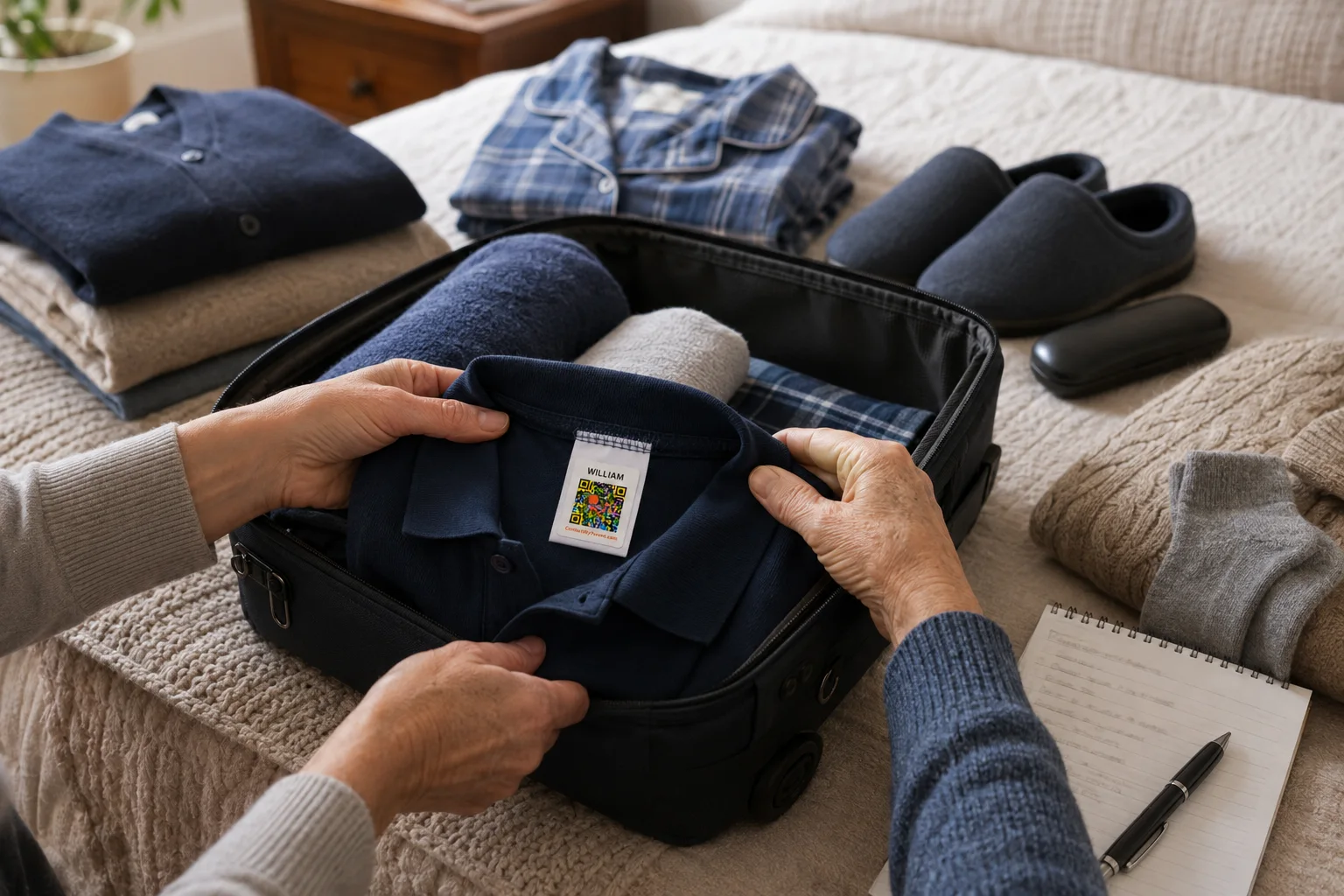
NIA's guidance on this is one sentence long and worth quoting exactly: “If you think the person might remove an ID bracelet, label their clothes with a name and phone number.” People with dementia take bracelets off. They pick at pendants. They do not take off the coat they walked out in, and a label sewn or ironed inside its collar goes wherever the coat goes.

Do both. Enroll in a safe return program: NIA points to the MedicAlert and Alzheimer's Association Safe and Found service on 800-432-5378, and notes there may be a charge. Keep a recent photograph. Tell neighbors and the local police that the person tends to wander, so the first call is not the first time they hear the name.
A bracelet comes off. A label in the collar does not.
ContactMyParent dementia clothing labels iron onto the care tag or inside the collar and carry a QR code. Whoever finds your parent, a neighbor, a shop worker, a bus driver, scans it with any phone camera, no app, and reaches you in seconds. You choose what they see, and the same profile can show conditions and medications, which is the emergency sheet in a form that walks out the door with the person. You can update it without replacing a single label.
The honest boundary. A paramedic will not scan a QR code, and a scan needs a phone, a signal and a live page. Emergency responders are trained to look for engraved medical jewelry, so this is not a replacement for it or for a safe return program. It is for the person who has a moment to check, which in a wandering episode is almost always who finds them first.
See the dementia clothing labelsIf they get out: the first 15 minutes
- Search the immediate area and the places they used to go: a former home, a former workplace, a church, a favorite walk. Confusion about time sends people to the life they remember.
- Do not search for more than 15 minutes. The Alzheimer's Association is specific: if the person is not found within 15 minutes, call 911 and file a missing person report. Say the words “has dementia.”
- Have the recent photo and the description ready. Many individuals who wander are found within 1.5 miles of where they disappeared, so the first hour is the one that counts.
- Afterwards, write down what happened: the time, the trigger, the door. Wandering repeats, and the second plan is built from the first episode.
Questions caregivers ask
What stage of dementia is wandering?
It can happen at any stage but is most common in the middle stages, when the person is still mobile and able to open doors but has lost the judgment and orientation to get home. The Alzheimer's Association reports that six in ten people living with dementia will wander at least once, so it is safer to plan for it early than to wait for a stage.
How do you stop dementia patients from wandering at night?
Combine three things: a night routine that improves sleep (regular times, morning light, exercise earlier in the day, no caffeine or alcohol, treated pain, nightlights), a home that makes leaving harder and audible (deadbolts high or low, door chimes, a pressure mat, departure cues out of sight), and identification the person cannot remove in case they do get out. No single measure is enough on its own.
How do you keep someone with dementia in bed at night?
You mostly cannot force it, and restraints are unsafe. Reduce the reasons they get up: a clear lit path to the bathroom, pain treated, hunger and thirst met before bed, fewer daytime naps, and no television during waking spells. A pressure mat at the bedside tells you when they are up so you can guide them back calmly.
Why do dementia patients have trouble sleeping at night?
The Alzheimer's Association says scientists do not completely understand it, but the disturbances result from the disease's impact on the brain. Restlessness and agitation in the late afternoon or early evening, often called sundowning, is common, and confusion about the time of day means night can feel like morning.
Should you use sleep medication for night wandering?
Ask the doctor before anything else. The Alzheimer's Association notes that sleep medications generally do not improve overall sleep quality in older adults and are associated with a greater chance of falls, fractures, confusion and a decline in the ability to care for oneself. Non-drug approaches come first.
What should I do if a person with dementia goes missing?
Search the immediate area and the places they used to go for no more than 15 minutes, then call 911 and report a missing person with dementia. Most people who wander are found within 1.5 miles of where they were last seen. Have a recent photo ready, and tell neighbors and local police in advance that the person may wander.
Free wandering safety plan
A one-page fill-in sheet: description and photo checklist, the places they may go, who to call, identification and home safety checklists, and the 15-minute rule at the top. Keep one by the door.
Download the PDF