Summer camp guide
Summer camp packing list: what to bring, what to label, and what to leave at home
Quantities for one-week and two-week sessions, the items that go in the counselor's hands rather than the trunk, and the five things parents only learn after the first summer. Your camp's own list wins on anything it names specifically.
Author: Muarij Kerio · Reviewed September 2026
The short answer
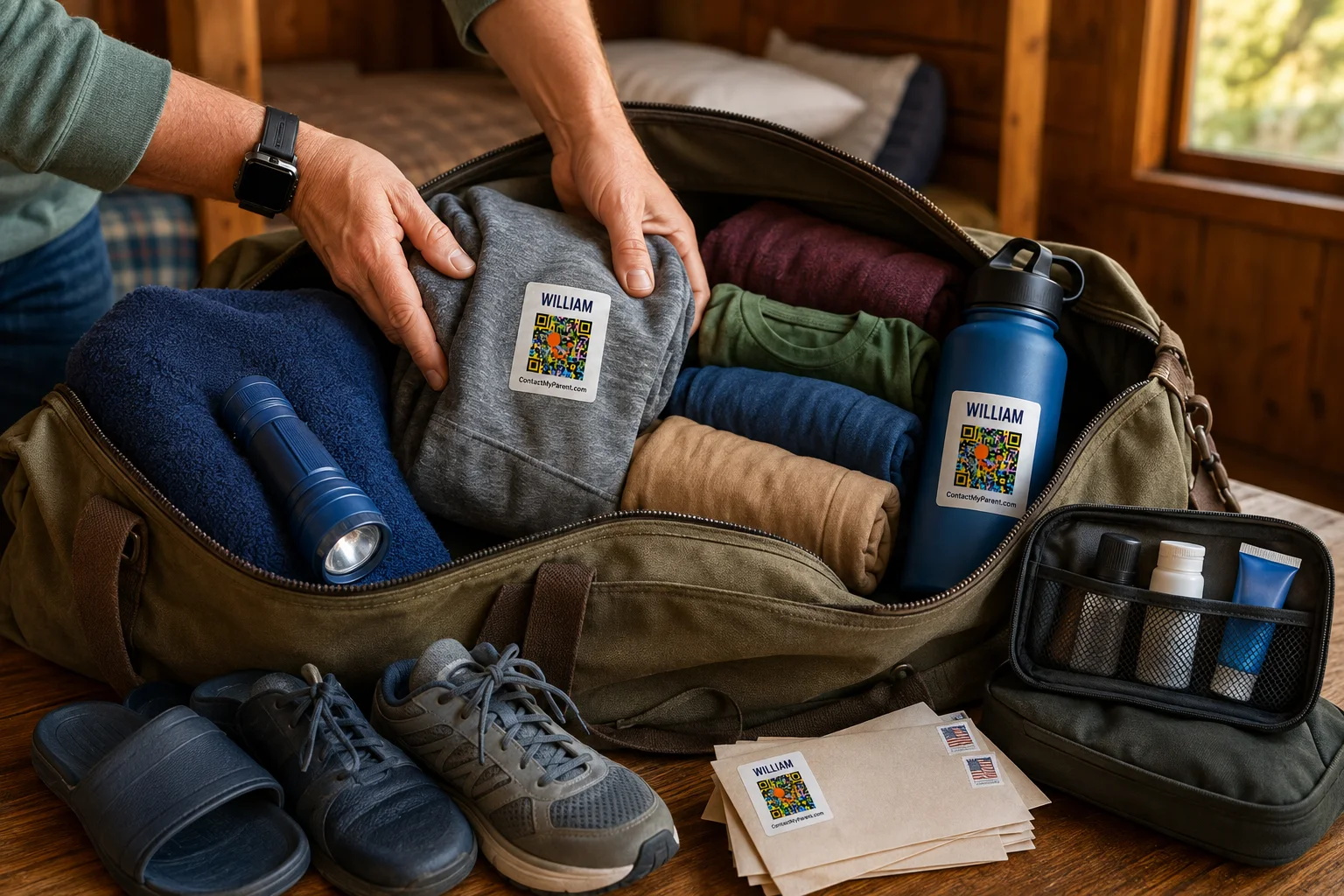
For a one-week residential camp, most children need about seven shirts, five shorts, eight sets of underwear and socks, two swimsuits, two sets of pajamas, two sweatshirts, a rain jacket, two pairs of broken-in sneakers, bedding, a toiletry caddy, a flashlight and a labeled water bottle. Double the clothing for two weeks unless the camp does laundry mid-session.
Day camp is a different list, covered below. Everything on both lists should carry a name.
Clothing, by session length
The two-week column follows a residential camp's own published list. The one-week column is scaled from it. Laundry frequency is the real variable, so ask the camp before you buy anything.
| Item | One week | Two weeks |
|---|---|---|
| T-shirts and tank tops | 7 | 10 to 12 |
| Shorts | 5 | 7 to 10 |
| Underwear | 8 | enough for two weeks |
| Socks (pairs) | 8 | enough for two weeks |
| Long pants or jeans | 2 | 2 to 3 |
| Sweatshirts or hoodies | 2 | 2 to 3 |
| Pajamas (sets) | 2 | 2 to 3 |
| Swimsuits | 2 | 2 to 3 |
| Rain jacket | 1 | 1 |
| Warm layer or fleece | 1 | 1 |
| Sun hat or cap | 1 | 1 |
| Sneakers, broken in | 2 pairs | 2 pairs |
| Sandals or water shoes | 1 | 1 |
Break in new shoes for two weeks before camp. Blisters end more camp days than rain does, and a camper who cannot walk to the lake is a camper who is not at camp.
Bed, bath, toiletries and gear
Bed and bath
- Sleeping bag, or twin sheets and a blanket
- Pillow and two pillowcases
- Two bath towels and two swim towels
- Laundry bag, labeled
- Shower sandals
Toiletries, in a caddy
- Toothbrush, holder and toothpaste
- Shampoo and soap in a container
- Brush or comb, hair ties
- Deodorant
- Sunscreen and insect repellent
- Anti-itch cream and lip balm
- Period supplies, even if not started yet
Gear
- Refillable water bottle, labeled
- Flashlight or headlamp with spare batteries
- Backpack for day trips
- Sunglasses and swim goggles
- Books, cards, a small game
- Writing paper and stamped, addressed envelopes
- A camp-approved camera
For the counselor, not the trunk
The American Camp Association's packing guidance ends with a short section most parents skip: an emergency contact sheet, and information about the child's medications, allergies, asthma or other conditions. These go to the counselor on arrival, not into the bag.
Medications travel in their original pharmacy containers and are signed in with camp staff. Never leave medication in a backpack or trunk, since camps confiscate it and children forget it.
Packing for girls, the practical additions
- Period supplies, whether or not she has started. A first period at camp with nothing packed is a common and avoidable story. Include a small discreet pouch and a quiet word with the counselor.
- A third swimsuit if the camp swims twice a day, since suits rarely dry overnight in a cabin.
- Sports bras rather than anything with hooks, hair ties in quantity, and a wide-tooth comb for lake hair.
- Shower sandals, which matter more in shared bathhouses than anywhere else.
Day camp is a different list
A day camper carries everything home each night, so quantity does not matter and labeling matters more, because the same backpack, bottle and towel travel back and forth every day.
- Backpack the child can open alone
- Refillable water bottle
- Packed lunch and snacks, if not provided
- Swimsuit, towel and a plastic bag for the wet one
- Sunscreen applied before drop-off, plus a hat
- Sneakers on, sandals in the bag if there is water play
- A complete change of clothes
Label everything, and what actually survives
“Label everything” is one of the American Camp Association's core packing tips, and any camp office will tell you why. At the end of a session there is a bin of unclaimed hoodies, towels and water bottles, and a first name written in marker does not get them home.
Label these, without exception
- Every item of clothing, including socks and underwear
- Towels, sheets, pillowcase and sleeping bag
- Water bottle, flashlight, sunglasses and goggles
- The toiletry caddy and every bottle in it
- Both shoes of every pair, inside the heel
- The trunk or duffel, inside and out
What works on what
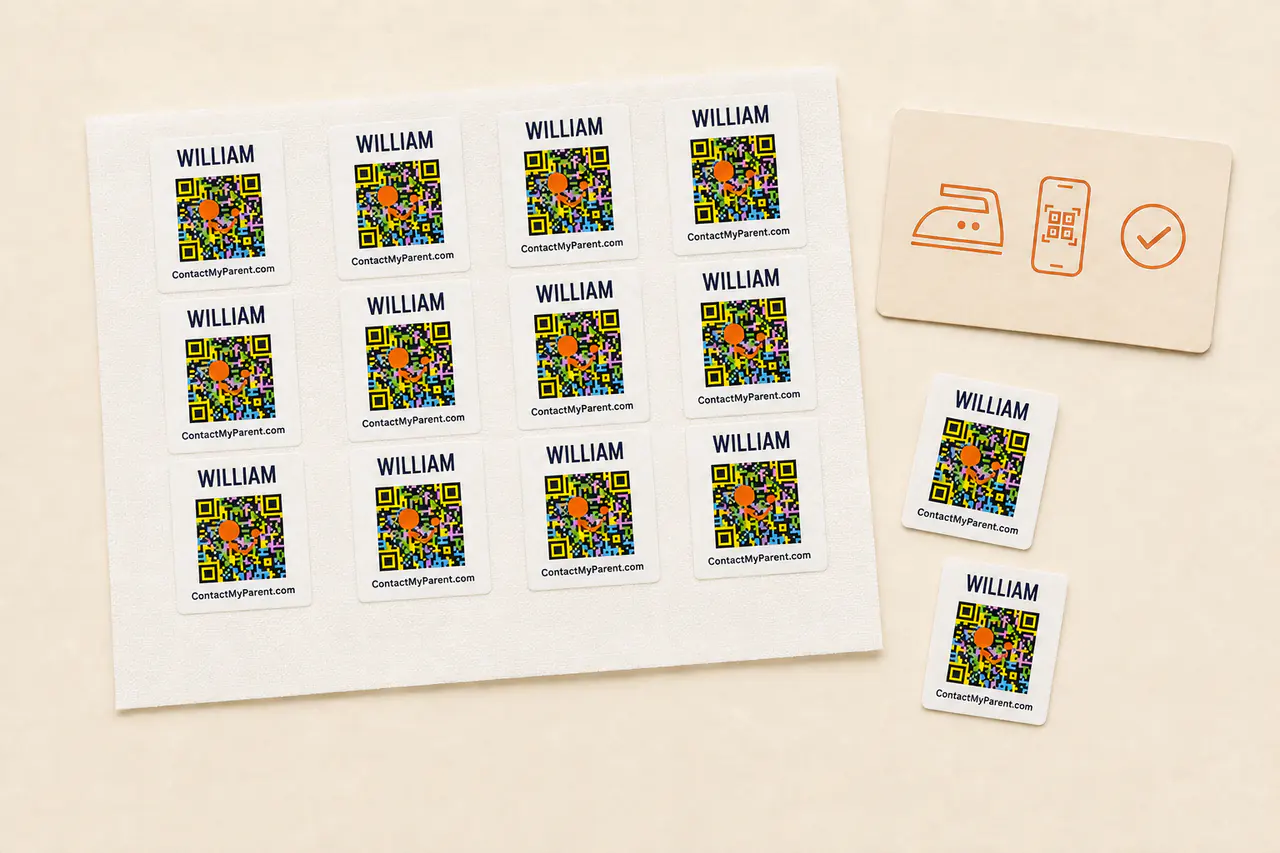
- Anything that goes through camp laundry: iron-on labels, rated for 50 plus washes including machine drying. Camp laundry is hotter and rougher than yours, and marker fades in a fortnight.
- Bottles, flashlights and hard gear: waterproof stickers on a clean, dry surface.
- Shoes: inside the heel, not the insole or tongue. Label both, since they get separated at the waterfront.
A name only helps if a stranger knows who to call
Inside the cabin a name is enough, because the counselor knows every camper. The lost-and-found bin, the bus home, the rest stop and the friend's car are where it stops working: whoever finds the hoodie has a first name and nothing to do with it.
ContactMyParent labels carry a QR code. Whoever finds the item scans it with any phone camera, no app, and reaches you, and you decide whether they see a number or a private message form. The same profile can carry allergies and medications, which is the counselor's emergency sheet in a form that travels with the child rather than sitting in a file at the office.
See the iron-on labelsWhat not to bring
- Phones, tablets and gaming devices. Most residential camps ban them outright, and a camp's own list will say so.
- Valuables and jewelry, which have no safe place in a cabin.
- Food and candy, which attract animals and break other campers' allergy rules.
- Anything you would be upset to lose permanently. Assume one item per session does not come home.
Five things parents learn the hard way
- Pack with your camper, not for them. If they did not see it go in, they do not know it exists, and it stays at the bottom of the trunk for two weeks.
- One name format everywhere: first name plus last initial. Every cabin has two Avas.
- Break in new shoes for two weeks before camp.
- Pre-address and stamp the envelopes. A stamped envelope is the only way a letter comes home. An unstamped one is a souvenir.
- Photograph the packed trunk. When the lost-and-found call comes in August, it is the only record of what actually went.
Questions parents ask
What is the rule of 3 at summer camp?
It is a camp heuristic, not a standard, and camps use it differently. The two common versions are three of each daily essential (three swimsuits, three towels, three pairs of shoes) and enough clothing for three days between laundry runs. Your camp's own list tells you which one applies, and if it names a number, use that number.
What is the most forgotten item for summer camp?
Stamped, pre-addressed envelopes, followed by a flashlight with batteries, shower sandals and a laundry bag. Period supplies are the item most often forgotten for girls, including those who have not started yet.
What should you not bring to summer camp?
Phones, tablets and gaming devices, which most residential camps ban. Valuables and jewelry, food and candy (which attract animals and break allergy rules), and anything you would be upset to lose permanently. Check the camp's own list, since bans vary.
How much clothing do you pack for one week of camp?
About seven shirts, five shorts, eight sets of underwear and socks, two of each of pajamas, swimsuits and sweatshirts, and two pairs of broken-in sneakers. If the camp does no laundry during the session, add two or three days' worth.
Should you label everything for summer camp?
Yes. The American Camp Association lists labeling everything as one of its core packing tips. Use iron-on labels for anything that goes through a hot wash and waterproof stickers on bottles and hard gear, and label both shoes of each pair and the inside of the trunk.
Free one-page camp packing checklist
Everything above on one Letter page with one-week and two-week quantities. Tape it inside the trunk lid.
Download the PDF