Data reference
How many children go missing in the US every year?
This subject has the worst statistics discipline of any area of child safety. Below, every figure is traced to its study and its year, and the ones that are routinely misused are named as such.
Compiled by Muarij Kerio · Sources checked 11 September 2026 · Free to quote with attribution
The short answer
There is no reliable current national figure, and the number most people have seen is from 1999. The honest answer has three parts.
- 132,167. That is how many missing child cases NCMEC, the national clearinghouse, assisted with in 2025. It recovered 90% of them. This is an operational caseload, not a count of the whole country.
- 2The 800,000 figure is 1999 data. It traces to Sedlak et al. (2002), which estimated 797,500 children reported missing in 1999. No current national study has replaced it, so it is still quoted as though it were this year's number.
- 3Most cases are runaways. About 92% of NCMEC reports involve endangered runaways. Stranger abduction, the scenario the question usually implies, was estimated at 105 victims nationally in 2011.
If you need one sentence: tens of thousands of children are reported missing to NCMEC each year, almost all are recovered, and the overwhelming majority are runaways rather than abductions. The rest of this page shows the working.
The headline figures
Read the years carefully. Several of the best-known numbers in this field are decades old.
99.8%
of caretaker-missing children were returned home alive or located
The number everyone quotes
“Around 800,000 children go missing every year.” It appears in news pieces, on charity pages and in the marketing of a great many child-safety products, including several sold by our competitors.
Its actual source is Sedlak et al. (2002), part of the NISMART programme, which estimated 797,500 children reported missing in 1999, a rate of 11.4 per 1,000. The same research found 1,315,600 children counted as “caretaker missing”, meaning a caregiver did not know where they were and was alarmed.
Three things follow. It describes 1999, before smartphones were ubiquitous. It is not an annual running figure, and there is no equivalent current national study to replace it with. And it counts reports, the overwhelming majority of which resolve quickly and safely.
The Crimes against Children Research Center, which produced much of this work, records that 99.8% of caretaker-missing children were returned home alive or located. That sentence almost never travels alongside the 800,000. (Crimes against Children Research Center)
What the cases actually consist of
The word “missing” hides four very different situations with very different frequencies.
| Category | Scale | What it means |
|---|---|---|
| Endangered runaways | 92% of NCMEC reports | A child who has left home or care. The largest category by an enormous margin, and the one almost never pictured when 'missing children' is said aloud. |
| Family abduction | 203,900 victims (1999 estimate) | Taken or kept by a family member, usually in a custody dispute. 43% were not considered missing by their caretaker at all. |
| Stereotypical kidnapping | 105 victims (2011 estimate) | Taken by a stranger or slight acquaintance and transported over 50 miles, held overnight, held for ransom, kept permanently or killed. The scenario the phrase evokes, and the rarest by orders of magnitude. |
| Lost, injured or otherwise missing | Not separately estimated in recent national data | Includes the child who walks off at a fair. Almost never generates a police report, so almost never enters a dataset. |
Sources: NCMEC Impact Report for the runaway share; Crimes against Children Research Center for the family abduction and stereotypical kidnapping estimates. Figures come from different years and different methodologies and should not be summed.
Set the extremes side by side. NCMEC handled 32,167 missing child cases in 2025, of which the great majority were runaways. The most recent national estimate of stranger kidnapping is 105 victims in a year. These two numbers are routinely blended into one impression, and they should not be.
The event nobody counts
Ask any parent of a young child whether they have ever lost sight of them in a shop, a park or a fair, and the answer is almost always yes. Ask how long it lasted, and it is usually minutes.
That event appears in no dataset on this page. It does not generate a police report, so it never reaches NCMEC, NISMART or law enforcement statistics. The most frequent child-safety incident that exists is also the one with no measurement behind it.
The nearest usable evidence is behavioural rather than incidence-based. The University of Michigan's C.S. Mott Children's Hospital National Poll on Children's Health surveyed 1,214 parents of children aged 5 to 12 in April 2018 about amusement parks and carnivals. It found 89% required their child to stay with an adult at all times, and that 21% had either not discussed what to do if separated or could not recall doing so. (Mott Poll, 2018)
What follows from the data
The realistic scenario the numbers support is a short, frightening separation that ends when an adult nearby helps. It is not the scenario these statistics are usually deployed to imply.
Two practical consequences. First, the cheapest intervention available is a conversation before you go in, and one in five families have not had it. Agree the rule: stay where you are, or find someone working here.
Second, a young child who cannot recite a phone number needs the number to be on them somehow, because the person who finds them will be an ordinary adult with a phone and no information. A wristband, a note in a pocket and a label in the clothing all solve that; they differ only in whether they survive the day.
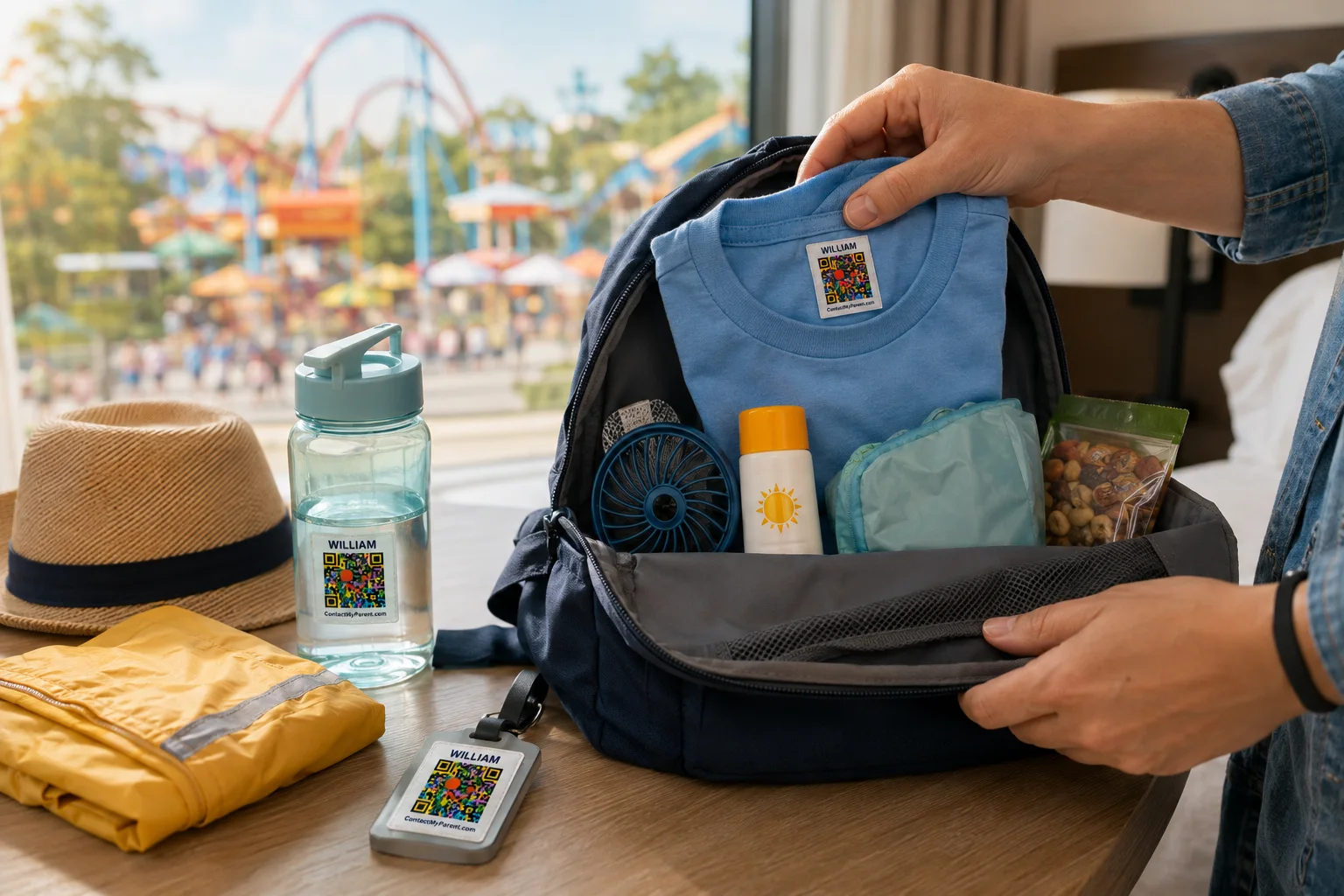
We make one of those three, so read this paragraph as interested. Iron-on name labels carry a first name and a QR code that opens your contact details on any phone camera, and there is a daycare version for children too young to speak for themselves. A phone number in laundry marker is free and worth doing tonight, so do that first. What it cannot do is change. A label points at a profile you control, so it carries a backup number as well as your own, it lets you keep both behind a message form if you would rather a stranger did not see them, and you can edit it from your phone in the moment something has actually gone wrong, with every label already ironed in pointing at whatever you just wrote.
What the data does not tell you
The '800,000 a year' figure is from 1999
It traces to Sedlak et al. (2002), reporting 797,500 children reported missing in 1999, a rate of 11.4 per 1,000. It is the most quoted child-safety statistic in circulation and it describes a year before smartphones, before Amber Alerts were nationwide, and more than twenty-five years ago. It is not a current annual figure, and anyone presenting it as one is misreading it.
'Missing' and 'abducted' are not the same word
The overwhelming majority of missing child cases are runaways. NCMEC's own 2025 impact reporting puts endangered runaways at 92% of reports. Marketing and news coverage routinely take a total that is 92% runaways and illustrate it with a stranger in a van. That is the single most common distortion in this subject.
Brief separations are not counted anywhere
The child who lets go of a hand at a theme park and is found nine minutes later by a stranger does not appear in NCMEC data, NISMART data or police statistics, because nobody files a report. This is the most common child-safety event there is, and there is no national dataset for it. Any number you see quantifying it is an estimate someone constructed, not a measurement.
Recovery rates are genuinely high
Nearly all caretaker-missing children (99.8%) were returned home alive or located, and NCMEC recovered 90% of the children in its 2025 caseload. Reporting the risks honestly means reporting this too. The realistic worry for a parent of a toddler is a frightening twenty minutes, not the scenario the statistics are usually deployed to suggest.
How to cite this page
Quote any figure here freely. Where a statistic originates with NCMEC, NISMART, the Crimes against Children Research Center or the Mott Poll, please cite them as the source and use this page only for the comparison and context.
Spotted an error or a better primary source? Tell us via our contact page and we will correct it and note the change.
Primary sources
- Crimes against Children Research Center, University of New Hampshire. Kidnapping and Missing Children. Summarising Sedlak et al. (2002), Hammer, Finkelhor & Sedlak (2002) and Wolak, Finkelhor & Sedlak (2016).
- National Center for Missing & Exploited Children. 2025 statistics and Our Impact.
- Sedlak, A. J., Finkelhor, D., Hammer, H., & Schultz, D. J. (2002). National Estimates of Missing Children: An Overview. NISMART, Office of Juvenile Justice and Delinquency Prevention.
- C.S. Mott Children's Hospital National Poll on Children's Health, University of Michigan. Thrill ride: keeping kids safe at amusement parks and carnivals (April 2018, n = 1,214).
Why a label company published this
We sell QR name labels, so the commercially useful thing for us would be to quote the 800,000 figure and leave it there. We think that number is misused, including by companies selling products like ours, and a page that corrects it is worth more than a page that exploits it. Every figure above is linked so you can check us.
Frequently asked questions
How many children go missing in the US every year?
There is no reliable current national figure. The widely quoted 800,000 comes from Sedlak et al. (2002), which estimated 797,500 children reported missing in 1999, a rate of 11.4 per 1,000. That is 1999 data. For a current operational number, NCMEC assisted with 32,167 missing child cases in 2025 and recovered 90% of them, but NCMEC's caseload is not the whole country either. Treat any single national number with caution.
How common is stranger abduction?
Extremely rare. The most recent national estimate found 105 victims of stereotypical kidnapping in 2011, defined as abduction by a stranger or slight acquaintance involving transport over 50 miles, being held overnight, held for ransom, kept permanently or killed. Half of those were sexually motivated crimes against adolescent girls, so even within that tiny group the typical victim is not the young child the fear usually pictures.
What are most missing children cases actually about?
Running away. NCMEC's impact reporting puts endangered runaways at 92% of the reports it handles. Family abduction, typically a custody dispute, is the next largest category. Abduction by a stranger is the smallest by a very wide margin.
How often do young children get separated from parents in public?
Nobody knows, and that is the honest answer. Brief separations at parks, fairs, shops and beaches almost never generate a police report, so they do not enter NCMEC, NISMART or law enforcement datasets. It is simultaneously the most common child-safety incident and the least measured one. Any specific number offered for it should be treated as an estimate rather than data.
Are children safer now than they used to be?
The best available evidence says yes, though the most cited datasets are old enough that this is hard to state precisely. Recovery rates are high: 99.8% of caretaker-missing children were returned home alive or located, and NCMEC recovered 90% of its 2025 caseload. Researchers at the Crimes against Children Research Center have long argued that the risk of stranger abduction is widely overstated in public discussion.
What should I actually do about it?
The Mott Poll found that 21% of parents of children aged 5 to 12 had not discussed what to do if they got separated, which is the cheapest gap to close. Agree a plan before you go in: stay put, or find a member of staff. For children too young to remember a phone number, put the number on them, whether that is a wristband, a note in a pocket or a label in the clothing.